
What is the difference between ‘Peak and Mountain’?
- 2017-11-16
- 0
The amount of thrilling excitement which one gets upon accomplishing a major feat is indescribable. People, no matter where they come from, aspire to experience a surreal, eccentric adventure that makes them want to go for more. Such feats are highly provocative yet arousing for many. Nevertheless, they do tend to make us wander into the oblivious that there will always be something greater to achieve in one’s life. Among those lies the ubiquitous, luminous peaks and mountains that soar at unimaginable heights waiting to be conquered.
Humans have always been fascinated with the longstanding ideology of accomplishing and achieving feats that will mark their names for the future generations to come. So, to fulfill these fascinations, we have traveled across continents and gave a try to do something extraordinary. One of the examples for it can be found in Nepal where some the grandiose presence of ‘Himalayas’ have made the country a hotspot for adventure enthusiasts whose passion for true, ultimate adventure never ends.
But if you dive further in, you will soon find out that there two major terms used by expert mountaineers and alpinists who seem to difference a mountain and a peak from one another. Yes, you can easily say what difference does it make if I remark a mountain by referring it as a peak or vice versa. Well, there’s a huge significance to both the terms which I will be discussing about from here onward. But before that let me advise you that trekking and peak climbing in Nepal are different from one another in terms of difficulty, technicality, finance and preparation. However, that’s a different topic for some another future blog.
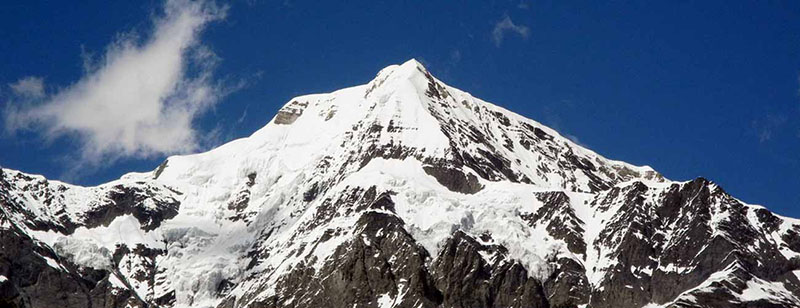
First of all, a particular mountain is a land form that is for some natural reasons has been elevated and inclined at a very high altitude and is usually steeper than a hill. This means that even though hills are also a landmass that stretches above the surrounding land territory. Mountains need to be taller and more specifically steeper than a hill in order to be termed a mountain, both geologically and linguistically. Mountains will have only one summit but can have several peaks of their own. This due to the fact that a summit of a mountain is the highest land area which can reached by a climber or a submitter. However, peak in a common sense is the highest point of the mountain. And by going with that term, you can basically say that any highest point that may form at any point around the mountain is a peak.
Mountains also require to be at a minimum height of 600 meters (2,000 ft) above sea level as per the standard height regulated by England’s Geological Society. And the process by which a mountain is formed is called ‘orogeny’ which commonly happens all around the world when two opposite rock layers push each other from the opposite sides due to which the entire crust mass of that particular area rises upward with their immense force.
Likewise, when a group of mountains lie beside one another, then that formation is known as a mountain range in which several mountains can be seen along each other in various directions. One of the example is the Annapurna mountain range which is located in the northwest part of Nepal. The entire Annapurna mountain range includes various magnificent Himalayan peaks which also includes the tenth highest mountain of the world – Mt. Annapurna (8,091m). And remarkably, it lies in the Annapurna region which is the most popular trekking of Nepal for trekking activities in terms of sheer numbers of tourists who visit this region after Everest region or Khumbu region.


